

Expedition 01 · Shape of the Team · Field notes
Shape of the Team: on small tasks, handing work off cost more
All 60 part 1 runs are in. Handing steps to a cheaper Sonnet worker cost about 20% more per passed task, and both setups passed every run. Part 2 tries the same thing on much bigger tasks.
All 60 runs for part 1 of the first expedition are in. Handing work off to the cheaper helper cost about 20% more per passed task, and both setups passed every run. Sojourner’s rule says delegating should save money, and that’s what the plan was set up to test, but I wasn’t sure it would. For tasks this small it makes sense to me that one agent doing the work itself comes out cheaper than a whole team.
What happened
If you missed the first field note, there are six small coding tasks and each one ran 5 times two ways. In the inline setup the lead agent, Claude Opus 5.5, does every step itself. In the delegate setup it hands steps to Sojourner’s worker, which runs on Claude Sonnet 5.5 at half the price per token. Hidden tests decide whether a run passed, and the number that settles it, written into the plan on October 29, is dollars per passed task at API prices.
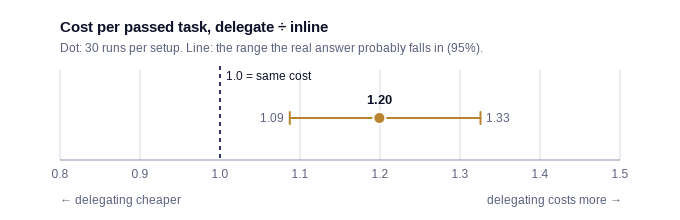
Delegating came to 1.20 times the cost of doing it inline. The real figure most likely falls between 1.09 and 1.33, so even the low end costs more. All 60 runs passed, so these tasks didn’t show any difference in quality.
| Inline (Opus does it all) | Delegate (Opus hands off to Sonnet) | |
|---|---|---|
| Runs passed | 30 of 30 | 30 of 30 |
| Cost per passed task | $0.495 | $0.593 |
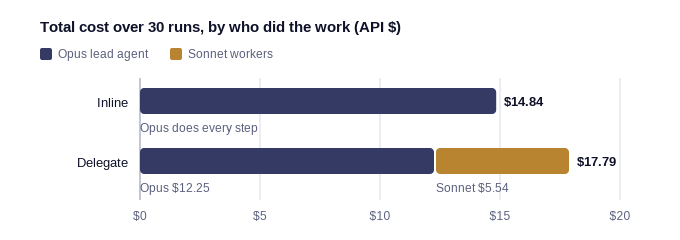
| Total cost, 30 runs | $14.84 | $17.79 |
| Average time per run | 130 s | 154 s |
| Average turns per run | 7.2 | 14.4 |
Delegating did take some of the load off Opus, and its part of the bill came down about 17%. The Sonnet workers cost more than that, though, so the total went up anyway. Delegate runs also took about twice as many turns. I think that’s mostly the lead writing up each handoff and then checking what came back.
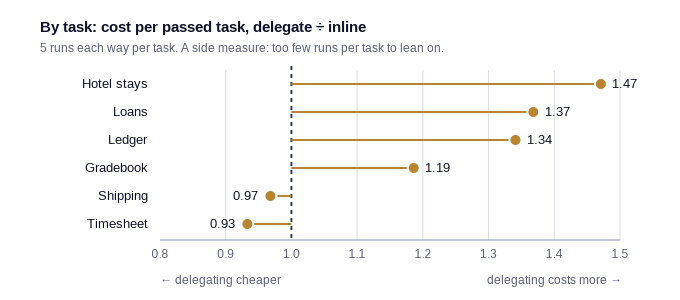
Two of the six tasks, timesheet and shipping, came out a little cheaper with delegating, and the other four cost 19% to 47% more. That’s only 5 runs each way per task, so I wouldn’t put much weight on any single task.
The plan only named two outcomes for cost: delegating is cheaper, or there’s no real difference. It didn’t have one for delegating costing more, so that label is my reading of the numbers and wasn’t written down ahead of time.
Why there’s a part 2
My guess is that these tasks were too small for delegating to help. Each run took about two minutes. The idea behind the rule is that a helper starts each step with a short, fresh context, so the lead isn’t re-reading one long conversation every turn, and that should mean fewer mistakes late in a long job. On a two-minute task the conversation never got long and nothing failed, so there wasn’t anything for the helper to save and the handoffs just added cost.
Part 1’s result stands for small tasks. It doesn’t say anything about bigger work, which is where the rule is supposed to pay off. It also changed two things at once, since the helper had both a fresh context and a cheaper model, so I can’t tell which one did what.
What part 2 changes
Part 2 uses four new tasks that are a lot bigger, 20 to 30 steps each and roughly 15 to 40 minutes a run, and each one runs four ways.
| Setup | Lead | Who does the steps | What it tells me |
|---|---|---|---|
| A | Opus | Opus itself | The baseline |
| B | Opus | A Sonnet worker | Sojourner’s rule, the main comparison (A vs B) |
| C | Opus | An Opus worker | A vs C is the fresh context alone, C vs B is the cheaper model alone |
| D | Sonnet | Sonnet itself | A vs D is the cheaper model with no delegating |
Only A against B decides the question. C and D are there to help explain whatever it shows.
A task only makes the cut if the baseline’s conversation passes 100,000 tokens in 2 of 3 trial runs and at least one of those runs passes. The time and turn limits come from trial runs of all four setups. Each setup gets 8 runs per task, 128 in all, on Claude Code 2.1.309 and the same Sojourner commit as part 1.
With the usage limits, part 2 will take a lot longer than part 1 did. If each run uses 10 to 20 times what a part 1 run did, the scored runs alone come to roughly 11 to 21 weeks on the 10% of my weekly plan usage I set aside for this. If the trial runs say it’ll go past 16 weeks, I’ll drop D first, then go down to 6 runs per task, then drop C, and keep A and B either way. The full plan is up here next to part 1’s.
The full part 1 write-up, with all the evidence, will come out with part 2. In the meantime, if you’ve run long jobs in Claude Code both ways, I’d like to know how long they had to get before delegating started to pay off for you. If you see a hole in the part 2 setup, let me know.


Steven Richardson
Writing from Sojourner AI Labs